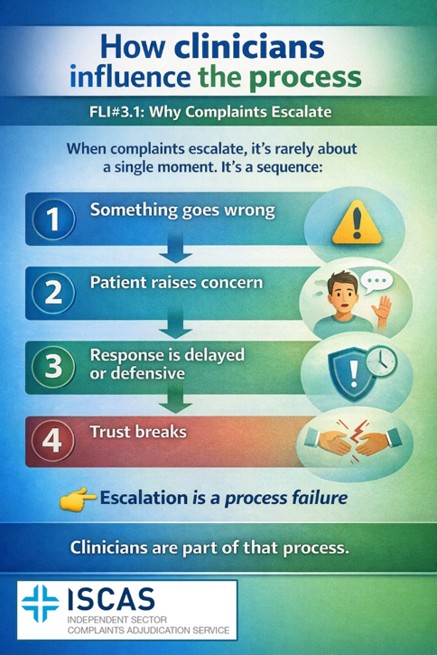
How clinicians influence the process
FLI#3.1: Why Complaints Escalate
With years of experience and analysis of trends, ISCAS has found that when complaints escalate, it’s rarely about a single moment.
It’s a sequence:
- Something goes wrong
- Patient raises concern
- Response is delayed or defensive
- Trust breaks
At that point, complainants often raise additional issues – concerns that may not initially have met the threshold for a complaint. This can complicate and lengthen the process of dealing with the complaint.
👉 Escalation is a process failure
Clinicians are part of that process – and play a crucial role in shaping how concerns are handled before they escalate.