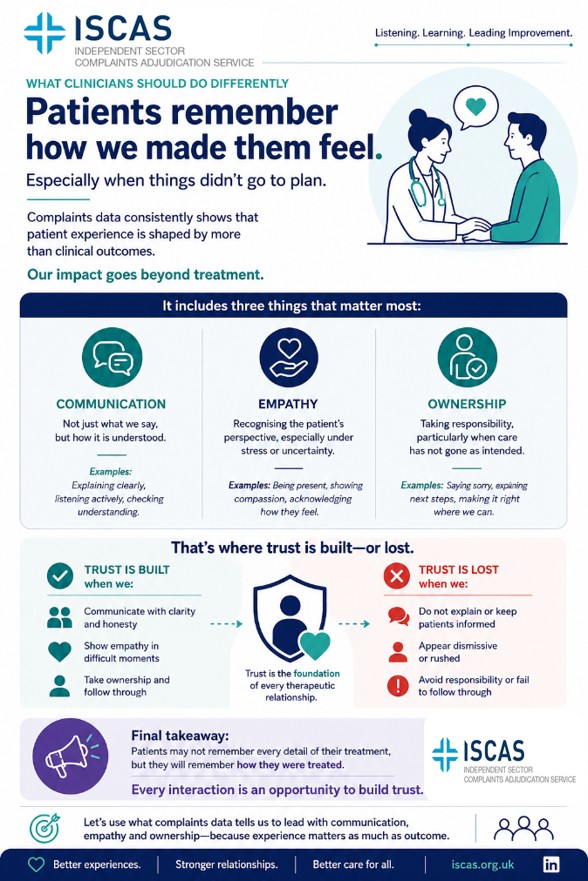
What clinicians should do differently
FLI#6.3: Final Call to Action
If there is one consistent message emerging from complaints data, it is this: Patients remember how we made them feel, particularly when things don’t go to plan (as well as when they do!!).
Clinical outcomes matter deeply. But when care falls short of expectations, it is often not the treatment itself that shapes the lasting impression, it is the human interaction around it.
For clinicians, this is a reminder that our impact extends well beyond diagnosis and intervention. It includes:
- Communication – not just what we say, but how it is understood
- Empathy – recognising the patient’s perspective, especially under stress or uncertainty
- Ownership – taking responsibility, particularly when care has not gone as intended
These elements are sometimes described as “soft skills”, but in practice they are foundational to trust.
Trust is not built in ideal circumstances alone. It is built, or lost, in moments of difficulty:
- When outcomes are uncertain
- When expectations diverge
- When patients feel vulnerable or unheard
Complaints data does not just highlight where systems fail. It often points to where connection falters.
So, the call to action is a simple, but demanding one:
To approach every patient interaction with the awareness that experience matters as much as outcome, and that how we communicate, respond, and take ownership will shape that experience long after the clinical episode ends.
Because in the end, patients may not recall every detail of their treatment, but they will remember how they were treated.